


Contents
Scroll to:
https://doi.org/10.26467/2079-0619-2026-29-3-8-17
Scroll to:
The pace of change in unmanned aviation is so rapid that the latest developments in this field become obsolete before they have passed the stage of technical design. This fate is most likely to befall the work currently being carried out in the Russian Federation on the development of unmanned air traffic control systems within the framework of the National Technology Initiative and other government programs, as they are aimed at the logistics of deliveries of relatively large (of kilograms) cargoes. However, the main challenge for unmanned aviation today is that drone delivery of small online purchases is the near future of mass retail, more than 50 percent of which is already online. This means billions of aerial deliveries per year using small drones flying on arbitrary, unpredictable trajectories, unguided by operators, with conflicts involving tens or hundreds of delivery drones. This perspective is out of step with current developments and requires new conceptual solutions. The paper suggests the main theses of the concept of unmanned air traffic control, taking into account the modern realities of the digital society. The algorithmic basis for automatic conflict resolution of small drones is formed – based on linear programming mathematical apparatus for optimal solution of the problem of safe passage of drones in areas of mass conflict.
Gorbunov A.L. Decentralization of unmanned air traffic control. Civil Aviation High Technologies. 2026;29(3):8-17. https://doi.org/10.26467/2079-0619-2026-29-3-8-17
The pace of change in unmanned aviation is so rapid that the latest developments in this field become obsolete before they even complete the technical design stage. This also applies to the ongoing work in the Russian Federation on creating unmanned traffic management (UTM) systems within the framework of the National Technology Initiative and other state programs.
The “Aeronext” Association, a sub-operator of the “Aerologistics” competition under the National Technology Initiative Project Support Fund, has announced the possibility of launching the first regular unmanned aerial vehicle (UAV) cargo delivery route between St. Petersburg and Moscow in 2028.
The key technological element for the operation of such a route is a UTM system that allows drones to automatically avoid collisions with other manned or unmanned aircraft moving along unpredictable trajectories. Final tests of “Aerologistics”, conducted in September 2024, demonstrated the existence of technologies to solve this problem when two UAVs are involved in a conflict. “Aeronext” sees the next stage as resolving conflicts for five aircraft. Similar results regarding collision avoidance were shown during 2024 tests of the “Jupiter” UTM system, developed by “Azimuth” (a subsidiary of Rostec). “Jupiter” evolved from “Galaktika” – a well-known air traffic management (ATM) system used as a baseline technological solution in the “Dome” experimental zone for unmanned aircraft systems application – a project of Tomsk State University of Control Systems and Radioelectronics, implemented under the Ministry of Education and Science’s “Priority-2030” program. Foreign UTM projects are not much different in terms of conflict resolution capabilities and overall development direction, e.g., CORUS-XUAM and PJ34 in the European Union, UTM in the USA, Open-access UTM in the UK, UOMS in China, JUTM in Japan [1].
The trend of all the aforementioned UTM developments – gradually increasing the number of conflict participants – seems natural but by no means optimal, as it fails to account for the pace of change in unmanned aviation. This pace is staggering, as most compellingly demonstrated by what is currently happening in the combat segment of this field with the emergence of swarms of small UAVs. For civilian UAV applications, the major future challenge stems from the fact that delivery of online purchases by small drones without operator control is the near future of mass retail [2]; this process is already actively underway in countries with the corresponding infrastructure. This implies billions of deliveries per year using UAVs. Such a prospect imperatively demands a solution to the main UTM problem of conflict situations involving UAVs, with the following approximate parameters:
a) conflict participants – autonomous self-managing small UAVs (hereinafter aerial drones, AD);
b) number of simultaneous conflict participants – dozens, possibly hundreds;
c) frequency and density of conflict occurrence – hundreds per cubic kilometer per hour;
d) localization of conflicts – a few hundred meters above ground.
Current air traffic management (ATM) systems as a basis for UTM are of little use – even simple observation of the air situation in the form of swarms of thousands of AD (see the telling title of work [3]) on today’s flat screens is impossible; the solution to this problem is already being actively sought in leading world aeronavigation centers in the field of augmented reality technologies. Forecasting and resolving mass conflicts of AD from a single ATM center is impossible.
Consequently, the key word for UTM in the near future will be “decentralization” or “distribution”. This phenomenon is characteristic of any mass-service system with intense stochastic traffic; examples include the Internet with distributed routing control of information packets or blockchain with distributed management of a distributed database.
Applied to UTM, decentralization means resolving conflict situations “on the spot”, with a random assignment of the controller role to one of the conflict participants (most likely the first AD that detects the conflict) and automatic transfer of this role. This implies the need to equip all UAVs with a standardized software dispatching module (DM) with standardized communication means. Automatic distributed UTM will require the DM to include a component for identification and determination of its own spatial position. Already today, UAVs weighing > 500 g are typically equipped with an ADS-B module, but given the problems of satellite navigation signals in urban environments, there will likely be a fusion with positioning via mobile communication stations (already being studied in “Jupiter”) and, more importantly, with autonomous optical positioning.
The main results of this article are:
To date, several models for resolving UAV conflicts that could be used in the DM have been developed worldwide. General information on the Russian regulatory framework for small civilian UAVs can be found in [4]. In the simplest cases, a functional element of the DM can be an analytical solution using the Lagrange multiplier method to determine a point belonging to the first segment and located at a given distance from the second segment, as proposed in [5].
Close to the specifics of conflict situations with multiple participants (although not implying decentralization of control) is the conflict resolution model at UAV trajectory intersections described in [6]. The authors propose the concept of a spatial matrix – a “drone-cell” containing horizontal and vertical corridors with control logic based on the introduced notion of an approach vector (fig. 1). Computer simulation of 954 conflicts involving 386 UAVs in an 8×8×8 drone-cell yielded a time of 0.45 milliseconds for determining conflict resolution actions.
A strategy called CONCORD resolves UAV conflicts using the concept of correlated equilibrium [7], which includes returning UAVs to their nominal trajectory after evasive maneuvers. Reference [8] proposes an automated conflict prevention algorithm for small low-altitude UAVs that ensures aircraft safety under uncertainty, based on a Markov decision process.
Various spatial lattice structures have become popular among researchers as approaches for conflict resolution [9] and UAV trajectory optimization [10]. Reference [11] proposes an iterative geometric approach for conflict resolution by breaking down a multi-conflict problem into simpler sub-problems. Another geometric approach based on space-time prisms was proposed in [12]. Reference [13] discusses a four-dimensional trajectory representation structure based on a spatial grid for conflict detection.
A pronounced drawback of existing models is the matrix nature of the spatial structures used for resolving mass conflicts of AD, which means that AD move along piecewise-linear trajectories with orthogonal adjacent segments coinciding with predetermined corridors (as shown in Figure 1). This leads to an increase in the time required to traverse the conflict resolution zone (CRZ) compared to a trajectory consisting of arbitrarily oriented segments. The following section proposes a framework for finding such trajectories, the advantage of which is analogous to the advantage of area navigation over traditional ATM navigation.
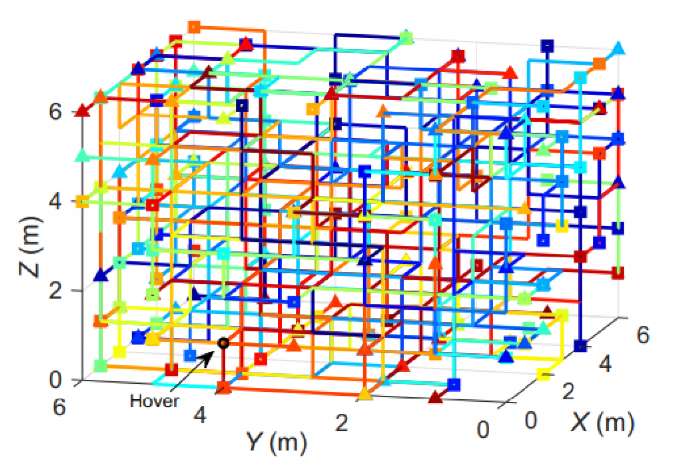
Fig. 1. The fragment of the illustration from [6]: trajectories of 100 UAVs with hovering and simultaneous entry into a 6×6×6 drone cage
Decentralization is not new in air traffic management research. This concept is discussed, for example, in [14][15]. However, the proposed algorithms bear the imprint of the legacy of ATM systems for controlling large airliners with conflict resolution in the horizontal plane: the article by NASA authors [14] determines turn angles during maneuvers of conflict participants, while [15] proposes resolving conflicts by manipulating aircraft speeds and finding these speeds using a neural network. Such approaches seem suboptimal for resolving mass conflicts of AD because they do not take into account the high maneuverability of small UAVs.
An extreme form of decentralization, where air traffic of a swarm of autonomous UAVs occurs without any external control, is presented by the approach described in [16]. The authors used the idea of self-organization inherent in biological systems, equipping each drone with a primitive collision avoidance mechanism for avoiding another drone moving in close proximity. An experiment conducted with a hundred such fully autonomous UAVs in a circular space 250 m in diameter, where each UAV was randomly assigned a destination point, demonstrated the practical viability of the method. Its undoubted advantages are low cost and scalability; however, the ability to resolve mass conflicts and efficiency in terms of CRZ transit time bring about serious doubts.
Problem Description
Formulation: to find safe trajectories for several AD to fly through a CRZ with multiple conflicts – points at which a collision of AD will occur when flying along trajectories specified before approaching the CRZ.
Optimality criterion: minimum total time spent by all AD to pass the CRZ while preserving the AD’s destination points.
Conditions: maintaining a safe separation interval. Trajectories are arbitrary. AD hovering capability is available.
Approach to Solving the Problem
It is proposed to reduce the management of passing through the CRZ to solving a linear programming problem with minimization of an objective function – the sum of the CRZ traversal times for all conflict participants. The sought variable values are the coordinates of the breakpoints of the piecewise-linear trajectories of the AD. The constraints are safe separation intervals that must be maintained for all points of all trajectories of conflict participants. The use of linear programming in UAV control problems has recently become very popular among researchers; see, for example, [17–19].
Notation Used
x, y, z – linear coordinates of points on AD trajectories;
n = 1...N, m = 1...N – AD number;
R – distance between ADs;
i = 1...I – the number of the linear segment of a piecewise-linear AD trajectory;
k = 1...K – number of the conflict inside the CRZ;
xnk, ynk, znk – linear coordinates of AD numbered n participating in conflicts k;
D – total length of the AD trajectory from its current position to the destination point;
Dni – length of the ith linear segment of the piecewise-linear trajectory of the nth AD;
xnik, ynik, znik – linear coordinates of breakpoints i of the trajectory of the nth AD participating in conflict k;
S – safe spatial separation interval between AD;
G – objective function of the linear programming problem;
V – flight speed of AD;
T – time from the moment a conflict threat is detected until the conflict would occur;
Assumptions and Limitations
Definition of a Conflict
A conflict is a violation of the safe spatial separation intervals S by AD moving at speed V over time intervals T. The value of T depends on the number of conflicts for which the linear programming problem has a solution. The product VT is the diameter of the CRZ in the form of a sphere (conflict sphere – CS).
Detection and Isolation of the CRZ
The DM of all AD constantly receive signals from other AD located within the CS sphere. AD signals contain information about their motion vectors. The DM determine the presence of a conflict threat inside the CS by extrapolating the motion vectors of the AD. If a threat exists, the first AD that detects it assumes the role of ATC and notifies all AD inside and on the boundary of the CS. This transitions all AD related to the CS into a hovering mode at their current positions (with a signal indicating participation in the conflict) and waiting for commands from the ATC. All ADs are obliged to follow the ATC instructions. The ATC DM marks around each point of each conflict inside the CS sphere a nested sphere Ck of diameter S, delineating conflict k. If one AD is found to be involved in multiple conflicts, the conflicts are resolved in the order they are detected; ATCs of subsequent conflicts wait for the resolution of previous ones, learning of this by the removal of the signal indicating participation in the previous conflict.
An example of a CRZ in the form of a CS sphere with three aerial drones AD1, AD2, AD3 and two conflicts C1 and C2 is shown in Figure 2.

Fig. 2. Example of a CS for sphere-shaped CRZ with three aerial drones AD1, AD2, AD3 and two conflicts C1 and C2
Calculation of CRZ Trajectories
The DM solves, using known methods, a linear programming problem to replace the straight-line trajectories from the current position to the destination point with several straight-line segments such that the end of each previous segment coincides with the beginning of the next one and this point lies inside sphere Ck. The sought variables are xnik, ynik, znik – the coordinates of the breakpoints i of the trajectories of AD numbered n participating in conflicts k. The objective function is minimized:
 (1)
(1)
where the lengths Dni depend on the sought coordinates of the start and end points of the straight-line segments i for all AD and all conflicts inside the CS;
subject to the constraints
xnik > xk0 – S/2
xnik < xk0 + S/2
ynik > yk0 – S/2
ynik < yk0 + S/2
znik > zk0 – S/2
znik < zk0 + S/2
(2)
where xk0, yk0, zk0 are the coordinates of the center of sphere Ck; and
 (3)
(3)
for all possible pairs of ADs participating in the conflicts.
Figure 3 demonstrates a possible result of resolving the conflict situation shown in Figure 2.
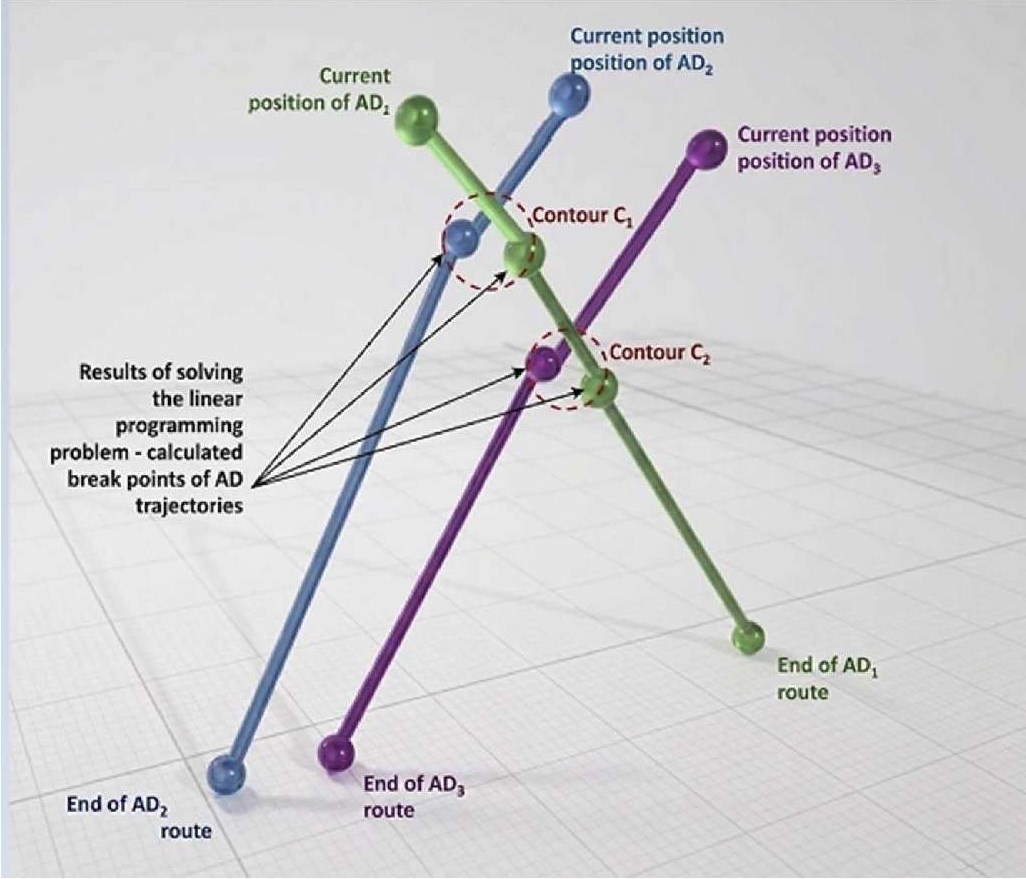
Fig. 3. Possible result of resolving the conflict situation shown in Figure 2
For large N and K, the problem (1)–(3) may not always have a solution. In such cases, the detected conflicts must be ranked by their estimated time, and problem (1)–(3) must be solved several times sequentially for a smaller number of conflicts that are predicted to occur first. While the first conflicts are being resolved, participants of the remaining conflicts receive a command from the DM to hover at the boundary of the CS sphere. If the AD (the dispatcher) is itself a participant in the first conflicts, then upon exiting the CS it transfers the dispatcher role to one of the ADs remaining in the CS from among the participants of the next temporal batch of conflicts.
The described scenario of distributed conflict resolution for automatic ADs within a future UTM implies that the DM functionality must include a number of basic functions:
The proposed general principles for organizing a decentralized UTM system and the mathematical framework for optimally solving the problem of safe AD passage through mass conflict zones have been described in outline. A working version will require accounting for a large number of details (UAV variability, communication delays, positioning errors, solution time, and many others), as well as simulation modeling for comparative assessment of efficiency and optimization of the proposed approach. This material is intended to serve as a stimulus for fruitful discussion among interested researchers.
Such a discussion seems extremely relevant, since the predicted huge number of AD delivery drones will make the management of this particular type of air traffic the primary task of ATM as a whole. Therefore, the development of automatic decentralized UTM mechanisms for small AD will obviously lead to the replacement of today’s air traffic management means and systems with these mechanisms – first for large UAVs using drone ports and airfields, and then, with necessary adjustments, for all aircraft. The basis for this prospect is the low operating cost of automatic solutions and the reduction of the human factor, which is the main cause of aviation accidents – suffice it to recall the air traffic controller errors that led to the disaster over the center of the US capital and the deaths of 67 people in January 2025.
The unmanned future of aviation generally means a controller-free UTM in particular. The enormous number of UAV conflicts in the air will require automatic resolution; the role of air traffic controllers will be reduced to manual control in emergency situations (equipment failures), which, among other things, will likely manifest in a radical reduction in the demand for air traffic controllers.
1. Aposporis, P. (2024). A review of global and regional frameworks for the integration of an unmanned aircraft system in air traffic management. Transportation Research Interdisciplinary Perspectives, vol. 24. ID: 101064. DOI: 10.1016/j.trip.2024.101064 (accessed: 10.06.2025).
2. Johnson, W. (2022). ATC in the era of advanced air mobility. The Journal of Air Traffic Control, vol. 64, no. 2, pp. 16–27.
3. Rumba, R., Nikitenko, A. (2020). The wild west of drones: a review on autonomous-UAV traffic-management. In: 2020 International Conference on Unmanned Aircraft Systems (ICUAS), Athens, Greece, pp. 1317–1322. DOI: 10.1109/ICUAS48674.2020.9214031
4. Chmelev, V.S., Kalyuka, V.I., Dmitrenko, M.E. (2022). Overview of control systems unmanned aerial apparatus for general use. In: Tekhnologii. Innovatsii. Svyaz: sborniki materialov nauchno-prakticheskoy konferentsii. St. Petersburg, pp. 279–286. (in Russian)
5. Titkov, I.P., Karpunin, A.A. (2022). Detection of conflicts and determination of safe separation boundaries for trajectories of a group of unmanned aerial vehicles based on conditional optimization. In: Budushcheye mashinostroyeniya Rossii: sbornik dokladov Chetyrnadtsatoy Vserossiyskoy konferentsii molodykh uchenykh i spetsialistov, vol. 2. Moscow: MGTU GA im. N.E. Baumana, pp. 196–202. (in Russian)
6. Nagrare, S.R., Ghose, D. (2024). Dronecage: a model for conflict resolution in aerial corridor intersections. Journal of Aerospace Information Systems, vol. 22, no. 3, 18 p. DOI: 10.2514/1.I011473 (accessed: 10.06.2025).
7. Tony, L.A., Ghose, D., Chakravarthy, A. (2022). Correlated-equilibrium based unmanned aerial vehicle conflict resolution. Journal of Aerospace Information Systems, vol. 19, no. 4, pp. 283–304. DOI: 10.2514/1.I011001 (accessed: 10.06.2025).
8. Ong, H.Y., Kochenderfer, M.J. (2017). Markov decision process-based distributed conflict resolution for drone air traffic management. Journal of Guidance, Control, and Dynamics, vol. 40, no. 1, pp. 69–80. DOI: 10.2514/1.G001822 (accessed: 10.06.2025).
9. Sun, Y., Li, H., Tong, X. et al. (2023). A multi-unmanned aerial vehicle fast path-planning method based on non-rigid hierarchical discrete grid voxel environment modeling. International Journal of Applied Earth Observation and Geoinformation, vol. 116, Paper 103139. DOI: 10.1016/j.jag.2022.103139 (accessed: 10.06.2025).
10. Choi, Y., Chen, M., Briceno, S., Mavris, D. (2020). Multi-UAV trajectory optimization utilizing a NURBS-based terrain model for an aerial imaging mission. Journal of Intelligent & Robotic Systems, vol. 97, pp. 141–154. DOI: 10.1007/s10846-019-01027-9
11. Acevedo, J., Capitán, C., Capitiin, J., Castaño, A., Ollero, A. (2020). A geometrical approach based on 4D grids for conflict management of multiple UAVs operating in U-Space. In: 2020 International Conference on Unmanned Aircraft Systems (ICUAS). Athens, Greece, pp. 263–270. DOI: 10.1109/ICUAS48674.2020.9213929
12. Siqi, H., Cheng, S., Zhang, Y. (2018). A multi-aircraft conflict detection and resolution method for 4-dimensional trajectory-based operation. Chinese Journal of Aeronautics, vol. 31, no. 7, pp. 1579–1593. DOI: 10.1016/j.cja.2018. 04.017
13. Neelakandan, D., Al Ali, H. (2023). Enhancing trajectory-based operations for UAVs through hexagonal grid indexing: A step towards 4D integration of UTM and ATM. International Journal of Aviation, Aeronautics, and Aerospace, vol. 10, no. 2, pp. 5–17. DOI: 10.58940/2374-6793.1815
14. Erzberger, H., Heere, K. (2010). Algorithm and operational concept for resolving short-range conflicts. Proceedings of the Institution of Mechanical Engineers, Part G: Journal of Aero-space Engineering, vol. 224, no. 2, pp. 225–243. DOI: 10.1243/09544100JAERO546
15. Brittain, M., Wei, P. (2019). Autonomous air traffic controller: a deep multi-agent reinforcement learning approach. Machine Learning, 10 p. DOI: 10.48550/arXiv.1905.01303 (accessed: 10.06.2025).
16. Balázs, B., Vicsek, T., Somorjai, G., Nepusz, T., Vásárhelyi, G. (2024). Decentralized traffic management of autonomous drones. Swarm Intelligence, vol. 19, pp. 29–53. DOI: 10.1007/s11721-024-00241-y
17. Premkumar, V.G.R., Scoy, V.B. (2025). Optimal positioning of unmanned aerial vehicle (UAV) base stations using mixed-integer linear programming. Drones, vol. 9, issue 1, ID: 44. DOI: 10.3390/drones9010044 (accessed: 10.06.2025).
18. Chen, Z., Wang, S., Chen, K., Zhang, X. (2025). Probability-constrained path planning for UAV logistics using mixed-integer linear programming. Modelling, vol. 6, issue 3. ID: 82. DOI: 10.3390/modelling6030082 (accessed: 08.10.2025).
19. Li, J., Ni, X., Hua, M., Wang, Q., Xu, M., Zhu, F. (2025). Integrating charging station location and delivery UAV route by a cascade optimization framework. In: 2025 IEEE International Mediterranean Conference on Communications and Networking (MeditCom), France, Nice, pp. 47–52. DOI: 10.1109/MeditCom64437.2025.11104427
Andrey L. Gorbunov, Candidate of Technical Sciences, Associate Professor of the Air Traffic Management Chair,
Moscow.
Gorbunov A.L. Decentralization of unmanned air traffic control. Civil Aviation High Technologies. 2026;29(3):8-17. https://doi.org/10.26467/2079-0619-2026-29-3-8-17
 Email this article (Login required)
Email the author (Login required)
Email this article (Login required)
Email the author (Login required) 


