


Contents
Scroll to:
https://doi.org/10.26467/2079-0619-2026-29-3-48-58
Scroll to:
Modern small unmanned aerial vehicles (UAVs) perform a wide range of missions, requiring high efficiency in various, often conflicting, flight conditions. Conventional airfoils, optimized for a single specific condition, exhibit suboptimal performance in others, limiting the overall flight capabilities of the vehicle. A promising solution to this problem is the use of a morphing wing, capable of changing its shape in flight. This paper presents a simplified method for the multi-objective optimization of an airfoil for such a morphing wing. To overcome the computational complexity of the classical Pareto front approach, especially with a large number of flight conditions, the multi-objective problem was reduced to a single-objective form. This was achieved using the weighted sum method, where the objective functions (drag coefficients for each flight condition) were normalized relative to their reference values. The weights were calculated based on a physical parameter – the Reynolds number – enabling the optimizer to prioritize the most important cruise regime. The airfoil geometry was parameterized using the Class-Shape Transformation (CST) method, and for fast and accurate aerodynamic calculations, the NeuralFoil tool, based on physics-informed machine learning, was used. The study solves two optimization problems: for two and four flight conditions. The results of the two-point optimization are in good qualitative and quantitative agreement with data obtained independently by more complex methods. Results demonstrate that employing an idealized curvature adaptation mechanism enables the compromise airfoil to achieve 82.7–87.5% of the aerodynamic efficiency of reference airfoils, each optimized for a single specific condition. The proposed method demonstrates a significant reduction in computational costs while maintaining high efficiency of the design solutions.
Skorobogatov S.V., Buturov D.A. Morphing wing airfoil optimization for small unmanned aviation vehicle. Civil Aviation High Technologies. 2026;29(3):48-58. https://doi.org/10.26467/2079-0619-2026-29-3-48-58
Modern small unmanned aerial vehicles (UAVs) are tasked with a wide range of missions, necessitating operation across various and often conflicting flight conditions. This imposes contradictory demands on the aerodynamic performance of the wing, as an airfoil optimized for one specific flight condition typically exhibits suboptimal performance in another. The use of a morphing wing, capable of dynamically altering its shape in flight, presents a potential solution to this challenge [1].
Morphing wings can be broadly classified based on the specific parameters they alter during flight. A particular category of interest is the variable-camber morphing wing [2][3]. Smooth camber variation not only allows the airfoil parameters to be adapted to current flight conditions but can also enhance the lift properties of the wing compared to conventional simple flaps, leading to reductions in takeoff and landing distances [4]. Furthermore, in comparison to slotted flaps, morphing flaps have the potential to reduce wing structural weight and mitigate unsteady loads on high-lift devices due to flow separation [5].
Compliant mechanisms, based on elastic material deformation, are of particular interest for small UAVs [6]. Lacking traditional rigid links and hinge joints, these structures offer potential advantages in reliability and maintainability, making them suitable for morphing wing applications [7]. For instance, the surfaces of an airfoil can be defined by an open contour, and the displacement of one end leads to a change in the camber of the trailing edge [8][9].
Research in the field of morphing wings often focuses on analyzing the effects of varying parameters on a given airfoil [10][11]. A fundamentally different approach was proposed in [12], where the constraints of a real camber morphing mechanism (FishBAC) were integrated directly into a two-level multi-objective optimization process involving a Pareto front. While scientifically rigorous, this approach becomes impractical for problems with numerous objecttives (N > 3) due to exponential growth in computational cost (increasing both population size and the proportion of non-dominated solutions) [13] and the complexity of visualizing the results [14].
The objective of this study is to develop and verify a simplified method for the multi-objective optimization of an airfoil for a small UAV’s morphing wing. This method is based on the scalarization of objective functions using weighting coefficients and normalization by reference values. Additionally, the effectiveness of an idealized variable-camber wing mechanism across different UAV flight regimes is examined.
Airfoil optimization for n flight conditions constitutes a multi-objective problem, formulated as finding a design variable vector X that minimizes a set of objective functions:
min { }, (1)
where  is the objective function, typically expressed as the drag coefficient for the i-th flight condition under specified targets and constraints.
This problem can be addressed using methods that construct an n-dimensional Pareto front. However, as noted in the introduction, the computational complexity of this approach becomes prohibitively high for a larger number of flight condition N > 3, especially when considering nested optimization over the angle of attack and camber values. This is due to the exponential growth in the required population size for genetic algorithms and the increase in the proportion of non-dominated solutions [13].
To reduce computational complexity, the multi-objective problem can be converted into a single-objective form using scalarization techniques. The weighted sum method, one of the simplest approaches [15], with normalization of the objective functions, defines an aggregated objective function F(X) as:
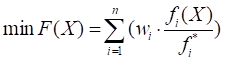 , (2)
, (2)
where  is the value of the i-th objective function (in the current study,
  );
);
 is the reference (normalizing) value for i‑th objective function;
 is the weight for the i-th objective function, with
  .
.
The reference values *6* were obtained by solving n independent single-objective optimization problems for each i-th flight condition:
Minimize: 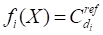 (3)
(3)
Subject to: 


Varying: (X) = (airfoil geometry parameters, angle of attack α).
Thus,  is the minimum achievable drag value for the i-th flight condition, obtained for a reference airfoil specific to that condition. Normalizing
  by
by  mitigates the issue of dominance by objective functions with larger absolute values (i.e., takeoff and landing).
The selection of weights  represents a critical step that inherently involves some subjecttivity [16]. In this study, for cases with N > 2 criteria, the weights were calculated using a method based on a physical parameter characterizing the flight regime (Reynolds number) and by identifying a control (most important) k-th condition, which was selected as the cruise flight mode.
For each j-th flight condition, a value  is calculated, characterizing its “proximity” to the control k-th condition based on parameter P (in this case,
  ):
):
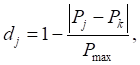 (4)
(4)
where  is the parameter value (Re) for the j-th flight condition;
 is the parameter value for the control k-th condition;
 is the maximum value of parameter P among all n criteria.
Then,  values were normalized by their sum to satisfy the
  condition:
 . (5)
. (5)
The airfoil geometry was parameterized using the Class-Shape Transformation (CST) method [17]. This approach provides a smooth and flexible definition of the airfoil contour using 18 variables. The symmetric NACA 0012 airfoil was selected as the baseline for initialization. For aerodynamic calculations, the NeuralFoil software [18] was employed. This tool utilizes physics-informed machine learning, offering significantly reduced computational time compared even to conventional panel methods. The optimization was performed within the AeroSandbox environment [19], which provides gradient-based optimization methods with automatic differentiation.
The following geometric constraints were imposed on the airfoil parameters for all calculated configurations: minimum relative thickness  , maximum relative thickness
  , and a leading-edge radius
  of the chord length c. A simplified kinematic model based on [20] was used to simulate the camber variation of the morphing wing. This model assumes a smooth rotation of points in the airfoil’s trailing-edge section by a uniformly increasing angle δ.
Two-objective optimization
To initially validate the simplified method, an airfoil optimization was performed for two UAV flight conditions described in [12]. This allows for an indirect comparison, demonstrating that the proposed approach yields results of the same order of magnitude as more complex methods.
The optimization was conducted in three stages:
1. For condition № 1 («Loiter»): minimize  subject to
  ,
, 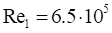 ,
,  , resulting in a reference airfoil with
 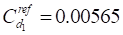 .
.
2. For condition № 2 («Dash»): minimize  subject to
 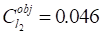 ,
, 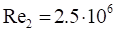 ,
,  , resulting in a reference airfoil with
 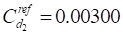 .
.
3. For the compromise airfoil: minimize 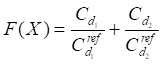 with constraints for both conditions and equal weights.
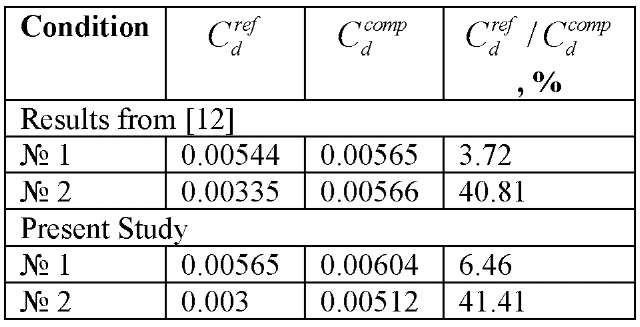
The optimized profiles are shown in Figure 1. Analysis of drag coefficients (tab. 1) shows that the compromise airfoil exhibits a 6.46% performance penalty relative to the Loiter condition and 41.41% relative to the Dash condition.
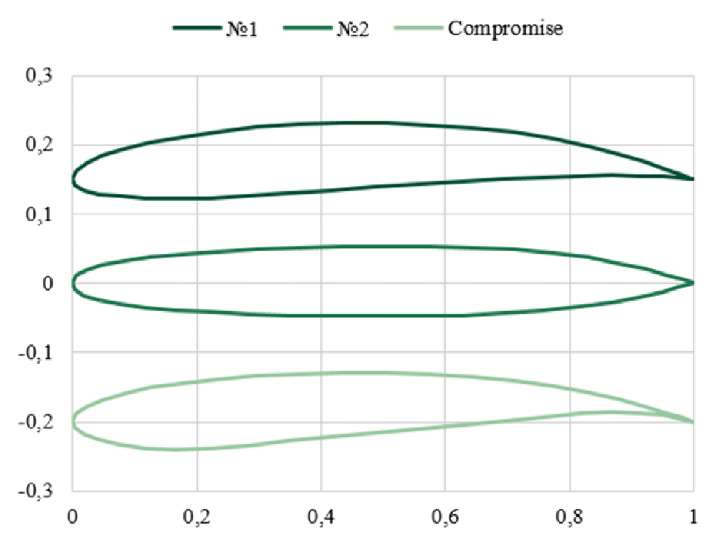
Fig. 1. Airfoils obtained from two-point optimization problem
It is important to note that despite differences in computational tools and optimization algorithms, the overall nature and order of magnitude of the results align with the data from the referenced publication, which reported performance losses of 3.72% and 40.81%, respectively.
Table 1
Comparison of airfoils Cd
Four-objective optimization
The primary objective of this study was the optimization of an airfoil for four flight conditions typical of a small UAV (tab. 2). The weights for the aggregate objective function were calculated based on the proximity of the Reynolds number of each i-th flight condition to the control k-th cruise flight condition (№ 3).
Table 2
Flight conditions in four-objective optimization problem
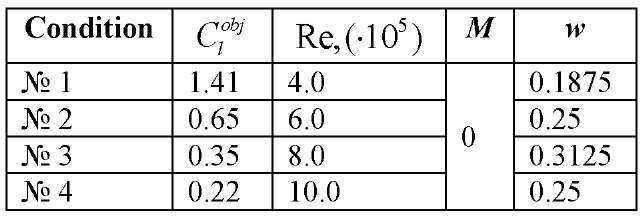
Reference airfoils for each condition were obtained by solving four independent single-objective optimization problems of the form (3). A single compromise airfoil was obtained by solving single four-objective problem considering the weights from Table 2 and normalizing  by the values
  of the reference airfoils according to equation (2). To adapt this compromise airfoil to each flight condition using a hypothetical device (with hinge at 70% chord), nested optimization tasks were solved to find the optimal camber deflection angles δ for minimizing
  in each condition. The optimal deflection angles δ for conditions № 1–4 were −5.0°, −3.0°, 0°, and +2.0°, respectively.
Figure 2 illustrates the shapes of the resulting airfoils – the compromise one obtained with and without objective function normalization, while Figure 3 presents the set of reference airfoils alongside the optimal variations of the compromise airfoil achieved through the morphing mechanism.
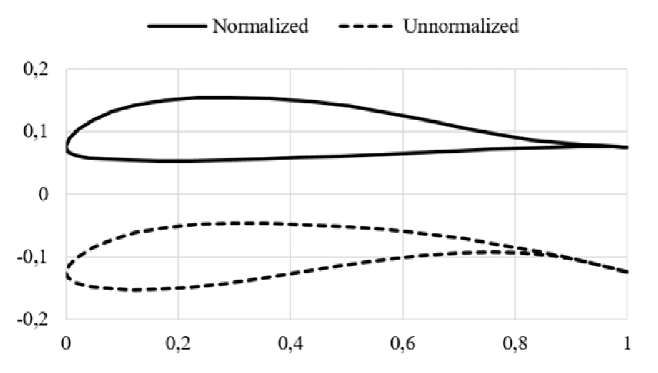
Fig. 2. Normalized and unnormalized compromise airfoil
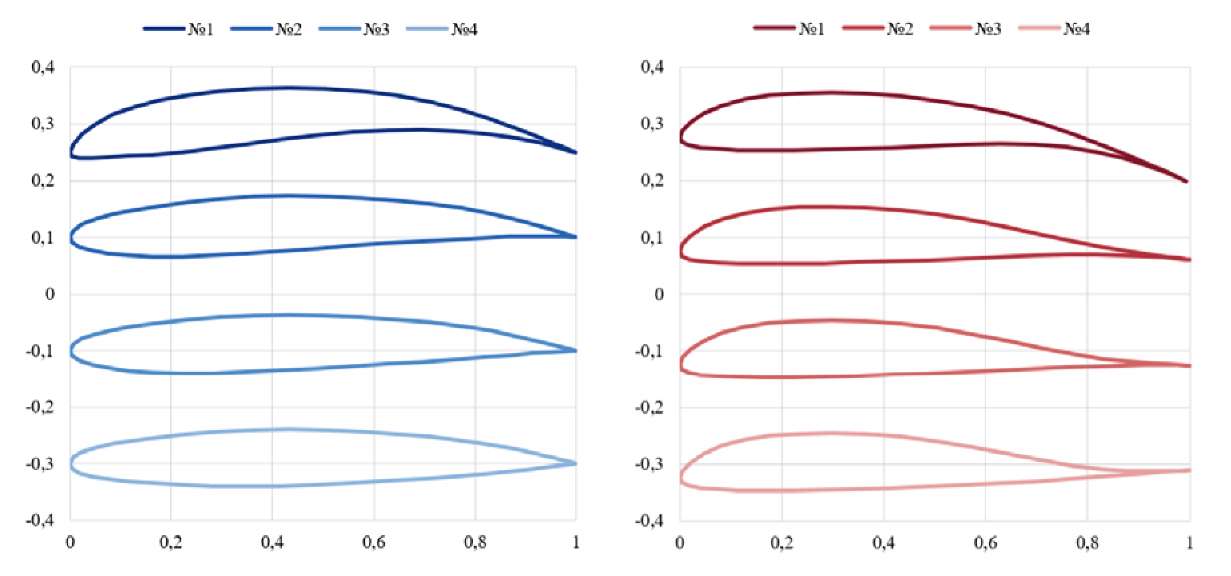
Fig. 3. Reference airfoils (left) and optimal variations of compromise airfoil provided by morphing mechanism (right)
Figure 4 presents the ratio of  value of the morphed compromise airfoil variations to the
 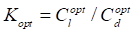 value of the reference airfoils for each flight condition. When using a static compromise airfoil (without the morphing mechanism), this ratio drops to 50.1%. Employing the camber adaptation mechanism with optimal deflection angles δ increased this ratio to a range of 82.7–87.5% across the different flight regimes.
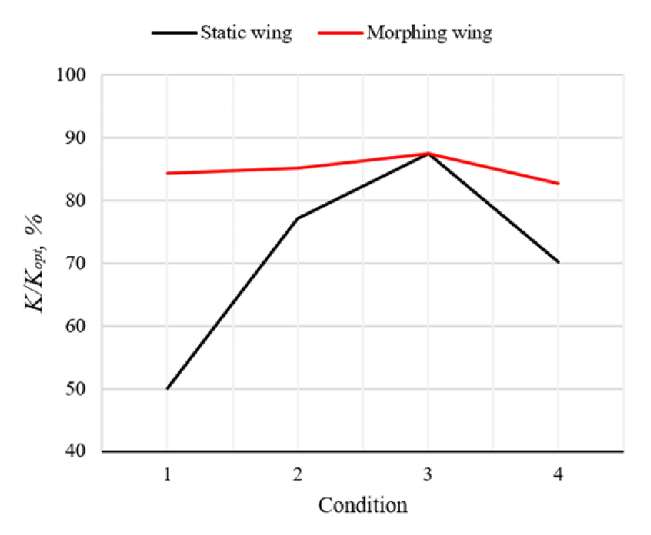
Fig. 4. Current 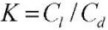 to optimal
 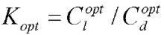 ratio for static compromise airfoil and morphing wing
Figure 5 demonstrates the stability and adequacy of the aerodynamic performance for the variations of the compromise airfoil. The well-behaved polar curves indicate that the optimization algorithm did not exploit potential errors in the computational or parametric methods to find unrealistic minima.
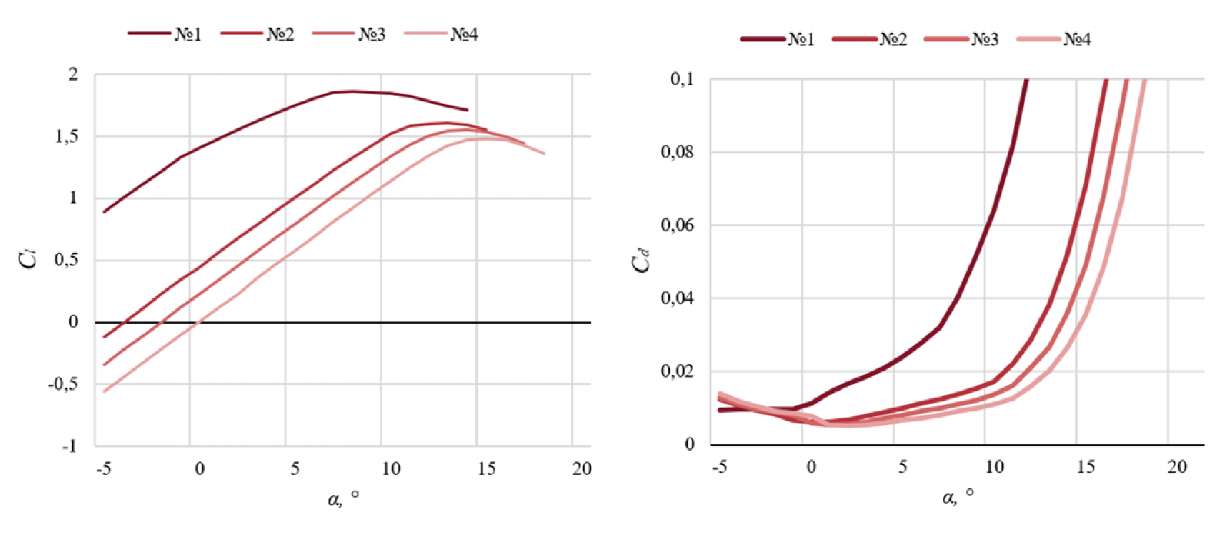
Fig. 5. Aerodynamic performance of variations of compromise airfoil
This work has presented and verified a method for simplifying the multi-objective optimization of an airfoil for a morphing wing, based on the scalarization of criteria. The method reduces the computational complexity of design problems where multiple UAV flight conditions must be considered.
The principal findings are as follows:
Reducing the multi-objective problem to a single-objective formulation significantly decreased computational costs while maintaining the compromise airfoil’s effectiveness, achieving 82.7–87.5% of the efficiency of the reference cases. The largest performance deficit was observed for the flight condition, which had the smallest weight  Key limitations of the adopted approach include the lack of explicit information on potential trade-offs between objectives and the inherent degree of subjectivity involved in selecting the control condition k and the parameter P for calculating the weights.
As mentioned earlier, morphing wing research often involves analyzing the effects of shape change on a given airfoil. For instance, the study in [11] defined part of the mean camber line of a symmetric airfoil using a third-order curve while varying the position of a hypothetical hinge (at 25%, 50%, and 75% chord). Reference [20] compared a simple plain flap with a morphing flap, demonstrating the aerodynamic advantages of the latter, partly due to delayed boundary layer separation.
A fundamentally different approach is exemplified by [12], which employed a two-level, multi-objective optimization with Pareto front construction. The method used in the present study cannot fully replace such an approach, particularly in problems where a complete picture of all possible trade-offs is essential. However, the method is well-suited when seeking a single high-quality solution with minimal computational resources. Other strategies for reducing computational cost include clustering flight conditions or optimal solutions [21], employing particle swarm optimization [22], or utilizing other scalarization techniques.
Future research directions include: 1) Refining methods for assigning weights – for instance, based on the relative mean dwell time or fuel consumption in a flight regime; 2) Integrating structural (topology) optimization algorithms for compliant mechanisms directly into the airfoil search process (an example is shown in [23]); 3) Extending the method to three-dimensional conditions while accounting for associated aerodynamic losses.
1. Barbarino, S., Bilgen, O., Ajaj, R.M., Friswell, M.I., Inman, D.J. (2011). A review of morphing aircraft. Journal of intelligent material systems and structures, vol. 22, no. 9, pp. 823–877. DOI: 10.1177/1045389X11414084
2. Martinez, J.M., Scopelliti, D., Bil, C. et al. (2017). Design, analysis and experimental testing of a morphing wing. In: 25th AIAA/AHS Adaptive Structures Conference. Grapevine, Texas, 8 p. DOI: 10.2514/6.2017-0059 (accessed: 18.06.2025).
3. Zaini, H., Ismail, N.I. (2016). A review of morphing wing. In: Mechanical Engineering Colloquium, Liverpool, England, 6 p. Available at: https://www.researchgate.net/publication/308647301_A_Review_of_Morphing_Wing (accessed: 18.06.2025).
4. Nguyen, N., Kaul, U., Lebofsky, S. et al. (2015). Development of variable camber continuous trailing edge flap for performance adaptive aeroelastic wing. In: SAE Technical Paper 2015-01-2565. DOI: 10.4271/2015-01-2565 (accessed: 18.06.2025).
5. Gubskiy, V.V., Druzhinin, O.V., Pavlenko, O.V., Mussa, Kh. (2024). Numerical studies of the effect of gaps during wing mechanization deflection on the aerodynamic characteristics of an aircraft model. In: X Polyakhovskiye chteniya: materialy mezhdunarodnoy nauchnoy konferentsii po mekhanike, St. Petersburg: OOO “Izdatelstvo VVM”, pp. 302–306. (in Russian)
6. Shuib, S., Ridzwan, M., Kadarman, H. (2007). Methodology of compliant mechanisms and its current developments in applications: A review. American Journal of Applied Sciences, vol. 4, no. 3, pp. 160–167. DOI: 10.3844/ajassp.2007.160.167
7. Zhang, Y., Ge, W., Zhang, Z., Mo, X., Zhang, Y. (2019). Design of compliant mechanism-based variable camber morphing wing with nonlinear large deformation. International Journal of Advanced Robotic Systems, vol. 16, no. 6. DOI: 10.1177/1729881419886740 (accessed: 18.06.2025).
8. Werter, N., Sodja, J., Spirlet, G., De Breuker, R. (2016). Design and experiments of a warp induced camber and twist morphing leading and trailing edge device. In: 24th AIAA/AHS adaptive structures conference, p. 315. DOI: 10.2514/6.2016-0315
9. Moulton, B., Hunsaker, D.F. (2021). 3D-printed wings with morphing trailing-edge technology. In: AIAA Scitech 2021 Forum, ID: 351. DOI: 10.2514/6.2021-0351 (accessed: 18.06.2025).
10. Marciniuk, M., Piskur, P., Kiszkowiak, Ł. et al. (2024). Aerodynamic analysis of variable camber-morphing airfoils with substantial camber deflections. Energies, vol. 17, no. 8, ID: 1801. DOI: 10.3390/en17081801 (accessed: 18.06.2025).
11. Woods, B.K.S., Fincham, J.H.S., Friswell, M.I. (2014). Aerodynamic modelling of the fish bone active camber morphing concept. In: Proceedings of the RAeS Applied Aerodynamics Conference, Bristol, UK. Available at: http://michael.friswell.com/PDF_Files/C365.pdf (accessed: 18.06.2025).
12. Fincham, J.H.S., Friswell, M.I. (2015). Aerodynamic optimisation of a camber morphing aerofoil. Aerospace Science and technology, vol. 43, pp. 245–255. DOI: 10.1016/j.ast.2015.02.023
13. Deb, K. (2011). Multi-objective optimisation using evolutionary algorithms: an introduction. London: Springer London, KanGAL Report Number 2011003, 24 p. Available at: https://www.egr.msu.edu/~kdeb/papers/k2011003.pdf (accessed: 18.06.2025).
14. Tušar, T., Filipič, B. (2016). Showing the knee of a 4-D Pareto front approximation via different visualization methods. In: Proceedings of the 19th International Multi-Conference on Information Society, pp. 52–55. Available at: https://dis.ijs.si/tea/Publications/Tusar16Showing.pdf (accessed: 18.06.2025).
15. Parkhaev, E.S., Semenchikov, N.V. (2015). Some aspects of airfoil optimization process for small size unmanned aerial vehicles application. Trudy MAI, no. 80, 20 p. Available at: https://trudymai.ru/eng/published.php?ID=56884 (accessed: 18.06.2025). (in Russian)
16. Podinovski, V., Potapov, M. (2013). Weighted sum method in the analysis of multicriterial decisions: pro et contra. Biznes-informatika, no. 3 (25), pp. 41–48. (in Russian)
17. Kulfan, B.M. (2008). Universal parametric geometry representation method. Journal of aircraft, vol. 45, no. 1, pp. 142–158. DOI: 10.2514/1.29958
18. Sharpe, P., Hansman, R.J. (2025). NeuralFoil: An airfoil aerodynamics analysis tool using physics-informed machine learning. Fluid Dynamics, 42 p. DOI: 10.48550/arXiv.2503.16323 (accessed: 18.06.2025).
19. Sharpe, P.D. (2021). Aerosandbox: A differentiable framework for aircraft design optimization: A thesis master of science. Massachusetts institute of technology, 130 p.
20. Skorobogatov, S.V., Buturov, D.A. (2025). Study of the variable camber morphing wing parameters influence on aerodynamic performance. Crede Experto: transport, society, education, language, no. 2, pp. 56–69. DOI: 10.51955/2312-1327_2025_2_56 (in Russian)
21. Sheikh, H.M., Lee, S., Wang, J., Marcus, P.S. (2023). Airfoil optimization using design-by-morphing. Journal of Computational Design and Engineering, vol. 10, issue 4, pp. 1443–1459. DOI: 10.1093/jcde/qwad059
22. Huang, J., Zhou, Z., Gao, Z., Zhang, M., Lei, Yu. (2017). Aerodynamic multi-objective integrated optimization based on principal component analysis. Chinese Journal of Aeronautics, vol. 30, issue 4, pp. 1336–1348. DOI: 10.1016/j.cja.2017.05.003
23. Jensen, P.D.L., Wang, F., Dimino, I., Sigmund, O. (2021). Topology optimization of large-scale 3D morphing wing structures. Actuators, vol. 10, issue 9, ID: 217. DOI: 10.3390/act10090217(accessed: 18.06.2025).
Sergey V. Skorobogatov, Candidate of Technical Sciences, Associate Professor of the Department of Aircraft and Engines,
Irkutsk.
Dmitry A. Buturov, Lecturer of the Department of Unmanned Aviation Systems; Master’s Student,
Irkutsk.
Skorobogatov S.V., Buturov D.A. Morphing wing airfoil optimization for small unmanned aviation vehicle. Civil Aviation High Technologies. 2026;29(3):48-58. https://doi.org/10.26467/2079-0619-2026-29-3-48-58
 Email this article (Login required)
Email the author (Login required)
Email this article (Login required)
Email the author (Login required) 


