


Contents
Scroll to:
https://doi.org/10.26467/2079-0619-2025-28-6-25-36
Scroll to:
The safety of the traffic of aircraft and special vehicles at an airfield is largely determined by the level of ground movement surveillance and control systems at the airfield, specifically within the airfield maneuvering zone, which includes the runway, taxiways, and apron. Modern surveillance systems, including airfield surveillance radars, airfield multi-position surveillance systems, and automatic dependent surveillance system equipment, have high tactical and technical characteristics that ensure the required level of ground traffic safety at the airfield. However, these surveillance systems are radio-based and therefore susceptible to radio interference, which can significantly worsen their performance or completely prevent their intended use. Advanced surveillance systems, particularly vibroacoustic monitoring systems, are not susceptible to radio interference and can operate in any weather and at any time of the year and day, however, they have a significant disadvantage – the inability to determine the coordinates of stationary objects at the airfield. A possible solution to the current contradiction is to integrate existing and prospective systems into a single, integrated airfield traffic monitoring and control system. This article, based on Markov theory for estimating random processes, develops algorithms for integrated processing of information on the movement of objects in the airfield area and proposes structural diagrams for an integrated airfield traffic monitoring and control system. It concludes that it is feasible to create an integrated airfield traffic monitoring and control system capable of detecting abnormal system operation.
Bolelov E.A., Borzova A.S., Romanenko N.M. Integrated ground movement control system at an airfield. Civil Aviation High Technologies. 2025;28(6):25-36. https://doi.org/10.26467/2079-0619-2025-28-6-25-36
Monitoring and surveillance of objects (aircraft, special-purpose vehicles) within the airfield maneuvering zone is performed by surveillance systems that are part of the Advanced Surface Movement Guidance and Control System (A-SMGCS). According to the ICAO classification, there are four levels of A-SMGCS functionality (internationally known as A-SMGCS – Advanced Surface Movement Guidance and Control System).
Level 1 A-SMGCS functionality includes air and ground situational awareness functions provided to the air traffic controller. A-SMGCS processes trajectory data received from coordinate and motion data meters within the airfield maneuvering zone.
The displayed information about the airfield maneuvering zone includes: aircraft stands; runway boundaries and centerlines; main taxiway boundaries and centerlines; apron boundaries; taxiway centerlines; restricted areas; aircraft and special-purpose vehicle coordinates, etc.
Implementation of Level 1 A-SMGCS functions does not require automation and is distributed between surveillance data processing tools and air traffic controller workstations.
Level 2 A-SMGCS functionality includes Level 1 A-SMGCS functions, as well as runway conflict display to the air traffic controller.
Level 3 A-SMGCS functionality includes Level 2 A-SMGCS functions, as well as:
Level 3 A-SMGCS functionality should allow every aircraft and special-purpose vehicle within the airfield maneuvering zone to have information about the location of all other aircraft and special-purpose vehicles. It should be noted that Level 3 A-SMGCS assumes that all aircraft and special-purpose vehicles moving within the airfield maneuvering zone are equipped with ADS-B automatic dependent surveillance (ADS) transponders.
Level 4 A-SMGCS functionality includes the functions of Level 3 A-SMGCS, as well as the provision of taxi route information to equipped aircraft and special-purpose vehicles, the provision of conflict information to all aircraft and special-purpose vehicles, the calculation of automatic conflict resolution options, and the provision of these to the air traffic controller.
The currently operational Vega A-SMGCS system complies with A-SMGCS Level 2 and processes information from the airfield surveillance radar (AFSR), the aerodrome surveillance radar (ASR), the aerodrome multi-position surveillance system (AMPSS), and the ADS-B system. It should be noted that information from the ASR has a low priority. The modern automated air traffic control system (ATC), “Galaktika”, operated as a backup at the Moscow ATM Center, includes A-SMGCS Level 4 functions.
Implementation of A-SMGCS Levels 2, 3, and 4 requires high-precision aircraft and special-purpose vehicle positioning, based on ICAO requirements and Eurocontrol recommendations. However, the actual accuracy of aircraft and special-purpose vehicle positioning directly depends on the accuracy of the AFSR and the AMPSS.
An analysis of the current levels of implementation of the A-SMGCS allows to conclude that AFSR, AMPSS, and ADS-B are currently used to determine the coordinates of objects in the airfield maneuvering area. All of these systems are radio-based and, despite operating in various frequency ranges, have one significant disadvantage: dependence on the level of radio interference. This disadvantage can be compensated for by implementing surveillance systems the operating principle of which is based on other physical principles. Such systems include vibroacoustic motion detection and control systems (further VADS) at the airfield. A domestically developed vibroacoustic system of this type, which has successfully passed testing, is the “Topot” vibroacoustic system developed by JSC “International Aero Navigation Systems Concern”. The “Topot” VADS is a set of sensitive acoustic wave sensors spaced out and located around the perimeter of the airfield maneuvering area, operating on the principle of coherent reflectometry [1–3].
The main advantage of the VADS is its independent, all-weather, automatic detection of moving aircraft, transport systems, and other objects within the aerodrome maneuvering zone. The VADS is completely interference-immune across the entire radio frequency range. However, the VADS also has several disadvantages, namely: lower accuracy compared to radio-based surveillance systems, measurement ambiguity, and, most importantly, the inability to observe and control stationary objects. Clearly, integrating surveillance systems operating on different physical principles will significantly reduce the impact of their shortcomings and improve airfield safety.
Therefore, the advanced surface movement guidance and control system (A-SMGCS) should include existing surveillance systems – the AFSR, the AMPSS, the ADS-B, and the prospective VADS system. Figure 1 shows the generalized structure of the VADS. The VADS is based on algorithms for integrated information processing (IIP) on the coordinates of objects within the aerodrome maneuvering zone.
The basis of the A-SMGCS is algorithms for integrated information processing (IIP) on the coordinates of objects in the airfield maneuvering zone. We will synthesize IIP algorithms using the Markov theory of random process estimation (MTRPE) [4, 5].

Fig. 1. Generalized structure of the A-SMGCS
The need for mathematical models of the output signals of airfield surveillance systems inevitably arises when developing aerodrome surveillance systems based on MTRPE methods. The more accurately the models represent the actual processes occurring in the surveillance systems (AFSR, AMPSS, ADS-B, and VADS), the more effectively the integrated information processing (IIP) algorithms based on these models will operate.
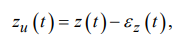
The measured value of an object’s motion parameter at the output of a measuring device is often represented as [6]
 (1)
(1)
where  is the measured value of the parameter,
  is the true value of the parameter,
  is the measuring device error.
The measuring device error generally has a constant (or slowly changing) component and a fluctuating component.
The constant component is caused, for example, by the systematic component of the measuring device’s methodical error, as well as other factors. A characteristic feature of the constant (slowly changing) component of the measurement error is its slow, usually monotonic, change over time.
The fluctuation component is caused by interference, instabilities in the measurement instrument, trajectory fluctuations of the observed object, etc. The fluctuation component of the parameter measurement error is unpredictable in both sign and magnitude. As studies [7–9] show, for the problem under consideration, the fluctuation component can be described with a sufficient degree of adequacy by a stationary Gaussian random process with zero mathematical expectation and a correlation function of the form
 (2)
(2)
where  is the variance of the fluctuation component of the measurement error;
  is the fluctuation spectrum width.
According to (2), the fluctuation component of the measurement error can be described by a first-order stochastic differential equation
 (3)
(3)
where  is the generating white Gaussian noise.
Since the practical implementation of information processing algorithms in modern A‑SMGCS systems is performed digitally, the signals, and consequently the errors at the meter’s output, must be represented as recurrence relations. Expressions (1) and (3) can be written as
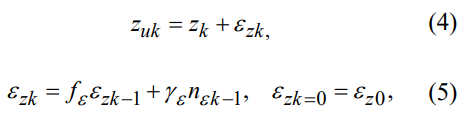
where  is a random Gaussian variable with zero mathematical expectation and unit variance; is the sampling step.
Thus, the signal at the A-SMGCS meter’s output can be completely described by expressions (4) and (5).
As shown in Figure 1, the A-SMGCS metering system includes the following surveillance systems: AFSR, AMPSS, ADS-B, and VADS. These systems determine the coordinates of objects located within the airfield maneuvering zone [10–12]. Based on (4) and (5), we write expressions for the signals at the A-SMGCS meter’s outputs:
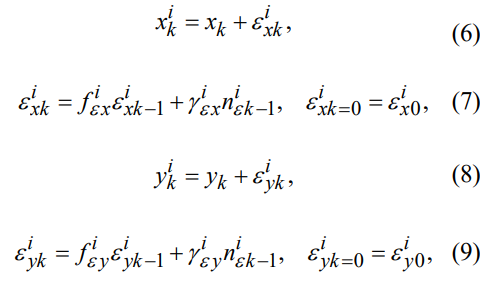
where the index i = 1…4 determines the parameter’s affiliation with a specific surveillance system (AFSR, AMPSS, ADS-B, and VADS, respectively).
The output signals of the surveillance systems are determined by expressions (6)–(9). To generate models describing the change in the true values of an object’s coordinates over time, it is necessary to set a hypothesis about the nature of the object’s movement across the airfield maneuvering area. The object may move in a straight line (uniformly, with acceleration or deceleration) or along a curved trajectory. The object’s movement patterns will vary. When constructing the A-SMGCS in this case, it is necessary to take into account the object’s movement in specific airfield zones, including turns, U‑turns, etc. An example of this approach to building an integrated information processing system is the Galaktika ATC surveillance data processing system, where an algorithm for estimating the object’s coordinates is developed for each object’s movement pattern (uniform rectilinear, accelerated rectilinear, or curvilinear). However, such an approach can hardly be considered productive. Furthermore, as shown in [13], when objects move, there are violations of the speed limit, violations of traffic patterns, non-observance of distance, etc. All this suggests that objectively there is a priori uncertainty about the nature of the movement of objects in the maneuvering area of the airfield.
The publication [5] discusses a method for overcoming a priori uncertainty about the nature of object movement. By analogy with [5], in measurement models (6), (8), we express the true coordinate values in terms of the measured values

Then the following equations are valid for the measurements at the output of any two surveillance systems

Rearranging the elements in equations (12) and (13) and replacing 
 we obtain

Expressions (14) and (15) represent the difference between the measurements at the output of the surveillance systems, which for certainty we call the measurement difference (MD). In (14) and (15) j = 1, ..., L, where L is the maximum possible number of MDs. For the surveillance systems under consideration L = 6, substituting (7) and (8) into (14) and (15), we obtain expressions for the MDs

A key feature of the functional and structural design of surveillance systems is the mutual independence of the object’s coordinate measurement channels. Therefore, it is advisable to synthesize the IIP algorithms for one of the coordinate measurement channels, for example, the x coordinate. For the y channel, the algorithm will be identical. To simplify notation, the “х” subscript is omitted.
By analyzing expressions (6)–(9) and (16), (17) as applied to the problem of synthesizing IIP algorithms based on the Markov theory of random process estimation (MTRPE), we define the state vector whose components are subject to estimation in the A-SMGCS:
 (18)
(18)
The dynamics of the state vector is described by the equation:
 (19)
(19)
where ΦXX – the state matrix, the nonzero components of which have the form:

GX is the disturbance matrix, the nonzero components of which have the form:
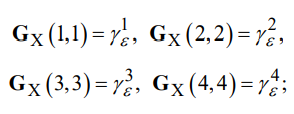
Nk is the disturbance vector, the components of which are determined by expressions (7).
The observation vector of the A-SMGCS is defined by expressions (16)
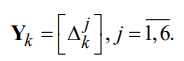 (20)
(20)
The dynamics of the observation vector is described by the equation:
 (21)
(21)
where ΦYX is the observation matrix, the nonzero components of which are of the form:
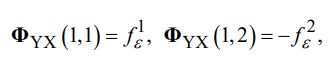

GY is the measurement error matrix, the nonzero components of which are of the form:
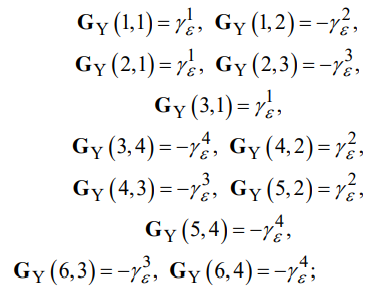
Wk is the measurement error vector.
The task of synthesizing an optimal algorithm for complex processing of information about the movement of objects in the airfield maneuvering zone is formulated as follows [14–17]: it is required to find the optimal estimate of the state vector  satisfying the criterion of minimum estimation error variance
  We define the estimation error as:

Then the synthesis criterion is determined by the expression:
 (22)
(22)

Fig. 2. Structural diagram of the A-SMGCS
In accordance with the methodology described in [5], the following algorithm was obtained based on (18)–(22) IIP:


The expression for  defines the structural diagram of the integrated A-SMGCS system, which is shown in Figure 2.
The following designations are introduced in the structural diagram: MDU – measurement differences unit; MRU – measurement residuals unit; CEU – coordinate estimation unit. Using the estimation of the state vector  , the components of which are measurement errors of the observation systems (18) using expressions (10), (11), an estimate of the coordinates of the object in the airfield maneuvering zone is formed in the CEU.

Fig. 3. Structural diagram of the A-SMGCS (with the procedure for detecting an abnormal mode)
A disadvantage of the developed IIP algorithms is that their normal operation requires the surveillance systems to be functioning properly. However, in real-world conditions, situations often arise where surveillance systems operate abnormally due to failures, malfunctions, etc., caused, for example, by deteriorating interference conditions.
A surveillance system failure is detected by its built-in control systems, after which the system’s output data is not used in the A-SMGCS. In the event of a surveillance system malfunction that does not result in loss of functionality, the control system does not detect the failure, and the surveillance system’s output data is used in the A-SMGCS. This leads to an increase, possibly significant, in the error in determining the object’s coordinates. Cases of complete suppression of the surveillance system by interference are possible, and consequently, the inability to use its output data in the A-SMGCS. Therefore, detecting abnormal operation of a surveillance system included in the A-SMGCS is a pressing task. For this purpose, the A-SMGCS should be supplemented with a procedure for detecting abnormal operation of systems.
There are several possible approaches to developing a procedure for detecting malfunctions in a surveillance system [18–21]. Approaches involving the introduction of a random unknown vector  , characterizing the structure and parameters of the system at each moment in time are presented in [20]. In this case, the equation of state (18) and observations (19) are dependent on the vector
  changing at random moments in time.
However, introducing the vector  necessitates describing its dynamics over time, i.e., developing mathematical models that describe changes in the state of the surveillance system.
The simplest and at the same time most productive approach involves assessing the properties of the quadratic form of measurement residuals. As shown in [5, 8], the quadratic form of measurement residuals can be represented by the expression:
 (26)
(26)
where 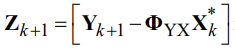 is the vector of measurement residuals, distributed according to the law
  with m – degrees of freedom, provided that all surveillance systems are operating normally. In this case, the number m is equal to the dimension of the observation vector.

Expression (27) defines the rule for detecting malfunctions in the surveillance system included in the A-SMGCS.
In the CEU, the coordinate values of objects are estimated based on measurements using the expressions:

The “х” and “y” indices of the parameter in (28) and (29) reflect the assignment of the corresponding coordinate to the measurement channel.
The structural diagram of the A-SMGCS, taking into account the procedure for detecting an abnormal operating mode of the surveillance systems, is shown in Figure 3.
Figure 3 shows that after detecting an abnormal operating mode of the A-SMGCS, namely, one of the surveillance systems, the CEU generates a command to reconfigure the measuring portion of the A-SMGCS. The output data from the surveillance system affected by interference or failure are excluded from integrated processing.
The resulting IIP algorithms, supplemented by a procedure for detecting abnormal operating conditions of airfield surveillance systems, make it possible to generate estimates of the coordinates of objects in the airfield maneuvering zone and reconfigure the measuring portion of the A‑SMGCS.
To determine the resulting algorithms, it is advisable to refine the parameters of the mathematical models of the surveillance system output signals based on statistical data on measurement errors and evaluate the potential and actual achievable performance characteristics of the IIP algorithms using mathematical modeling.
1. Alekseev, A.E., Tezadov, Y.A., Potapov, V.T. (2012). Statistics of intensity of backscattered semiconductor laser radiation in single-mode optic fiber. Technical Physics Letters, vol. 38, no. 1, pp. 89–92. DOI: 10.1134/S1063785012010178
2. Listvin, A.V., Listvin, V.N. (2005). Reflectometry of optical fibers. Moscow: LESARart, 150 p. (in Russian)
3. Gorshkov, B.G., Paramonov, V.M., Kurkov, A.S., Kulakov, A.T., Zazirnyi, M.V. (2006). Distributed external-action sensor based on a phase-sensitive fibre reflectometer. Quantum Electronics, vol. 36, no. 10, pp. 963–965. DOI: 10.1070/QE2006v036n10ABEH013273
4. Tikhonov, V.I., Mironov, M.A. (1977). Markov processes. Moscow: Sovetskoye radio, 488 p. (in Russian)
5. Yarlykov, M.S., Mironov, M.A. (1993). Markov theory of estimating random processes. Moscow: Radio i svyaz, 464 p. (in Russian)
6. Tikhonov, V.I., Kharisov, V.N. (1991). Statistical analysis and synthesis of radio engineering devices and systems. Moscow: Radio i svyaz, 608 p. (in Russian)
7. Kharin, E.G. (2002). Complex processing of information from aircraft navigation systems. Moscow: Izdatelstvo MAI, 264 p. (in Russian)
8. Mironov, M.A. (2007). Detection of the property changes of observed and nonobserved stochastic processes. Radiotekhnika, no. 1, pp. 39–45. (in Russian)
9. Rubtsov, V.D., Senyavsky, A.L. (2015). Method for calculating the noise distribution and its mixture with the signal from the experimental distribution curves ispolzovaniemi envelope interference. Informatizatsiya i svyaz, no. 2, pp. 57–61. (in Russian)
10. Erokhin, V.V., Lezhankin, B.V., Bolelov, E.A., Urbansky, D.Yu. (2024). Estimation of parameters of a multi-position surveillance system based on an adaptive Kalman filter. Scientific Bulletin of the State Scientific Research Institute of Civil Aviation (GosNII GA), no. 46, pp. 9–19. (in Russian)
11. Erokhin, V.V., Lezhankin, B.V., Fedorov, A.V., Urbansky, D.Y. (2024). Algorithm for estimating aircraft coordinates in a multiposition surveillance system based on adaptive signal filtering methods. Vestnik SPbGU GA, no. 2 (43), pp. 114–122. (in Russian)
12. Erokhin, V.V., Lezhankin, B.V., Malisov, N.P., Fedorov, A.V. (2025). Algorithm of comprehensive information processing in the integrated inertial-satellite navigation system based on the adaptive extended Kalman filter. Vestnik SPbGU GA, no. 1 (46), pp. 117–134. (in Russian)
13. Ivanov, R.A. (2023). Organization special-purpose vehicles and apron mechanization equipment traffic at Pulkovo Airport (St Petersburg). Aktualnyye issledovaniya, no. 9 (139), pp. 17–20. (in Russian)
14. Avramov, A.V. (2021). Method and algorithms of complex information processing onboard the aircraft for the benefit of definition of accessory of the purposes. Uspekhi sovremennoy radioelektroniki, vol. 75, no. 1, pp. 86–104. DOI: 10.18127/j20700784-202101-05 (in Russian)
15. Kuzmin, V.V., Achkasov, N.B. (2022). The algorithm of complex estimation of spatial characteristics of objects. Izvestiya TulGU. Tekhnicheskiye nauki, no. 2, pp. 474–480. DOI: 10.24412/2071-6168-2022-2-474-480 (in Russian)
16. Gorbai, A.R., Rasolko, N.M. (2022). Methods of complex data processing from the radar and the air reconnaissance station of the aviation complex. Radioengineering, vol. 86, no. 8, pp. 96–102. DOI: 10.18127/j00338486202208-10 (in Russian)
17. Arasaratnam, I., Haykin, S. (2008). Square root quadrature Kalman filtering. IEEE Transactions on Signal Processing, vol. 56, no. 6, pp. 2589–2593. DOI: 10.1109/TSP.2007. 914964
18. Bolelov, E.A., Sbitnev, A.V., Shalupin, S.V. (2014). The mathematical model of the signals at the output of onboard navigation systems, taking into account their sudden failures. Nauchnyy vestnik MGTU GA, no. 210, pp. 160–162. (in Russian)
19. Bolelov, E.A., Tsykarev, A.V., Sbitnev, A.V. (2015). An algorithm for monitoring the technical condition of an on-board flight and navigation complex, taking into account the information redundancy of the complex. Nauchnyy vestnik MGTU GA, no. 222 (12), pp. 175–181. (in Russian)
20. Grishin, Yu.P., Kazarinov, Yu.M. (1985). Dynamic systems resistant to failures. Moscow: Radio i svyaz, 1985. 176 p. (in Russian)
21. Sobolev, S.P. (2007). Integrity monitoring in airborne satellite landing system. Izvestiya vysshikh uchebnykh zavedeniy Rossii. Radioelektronika, no. 4, pp. 62–70. (in Russian)
Moscow
Moscow
Moscow
Bolelov E.A., Borzova A.S., Romanenko N.M. Integrated ground movement control system at an airfield. Civil Aviation High Technologies. 2025;28(6):25-36. https://doi.org/10.26467/2079-0619-2025-28-6-25-36
 Email this article (Login required)
Email the author (Login required)
Email this article (Login required)
Email the author (Login required) 


